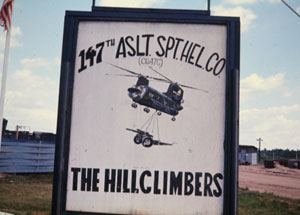

CAN THO, VIETNAM
An overview of the "city" of Can Tho, Vietnam will be portrayed. The information presented, except for the climate "statistics", is from one soldier's "journey" into the town during the Vietnam War era.
CLIMATE
- Can Tho's climate is tropical and monsoonal.
- It has two seasons.
- The rainy season is from May to November.
- From December to April, it is the dry season with very little rain, but there can be a lot of dust.
- During the dry season, there can still be a lot of humidity, and temperatures can easily climb to over 120 degrees Fahrenheit.
- The average annual humidity is 83%.
- The average temperature is 81 degrees Fahrenheit.
- Yearly rainfall is about 64 inches.
WAY OF LIFE
As can be seen from the photos, Can Tho's way of life is drastically different from that of the United States. The town was definitely at the lower levels of the American socio-economic status.
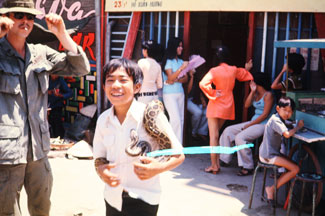
YOUNG ENTREPRENEUR
The boy on the street was trying to sell the snake, possibly a python, to one of the soldiers.
It seemed like almost anything could be sold there for a price.
TRANSPORTATION
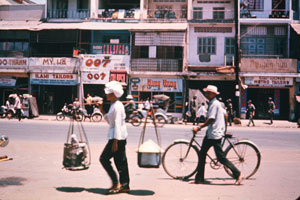
The transportation system is definitely different as compared to that found in America. The woman in the photo has to carry items in a very basic manner, with the weight of the baskets being balanced through a pole on her shoulders. The convenience of having automobiles readily available is not prevalent over there. Cars seemed to be more of a luxury for the Vietnamese people.
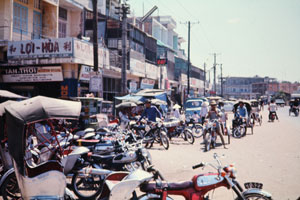
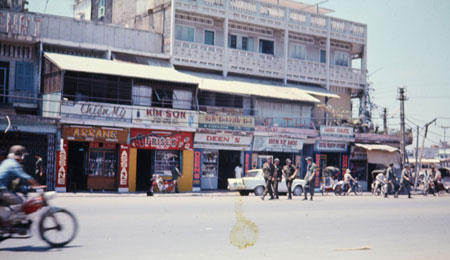
One of the major methods of transportation is via bicylces. Another transportation type was using a small motorcycle and a cart could be hooked onto the back of it for transporting people and items. This was called a cyclo.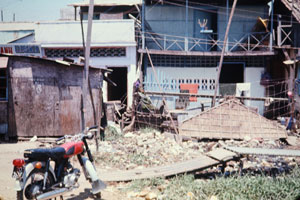
DWELLINGS
By U.S. standards, the housing would be considered as sub-standard since many of the dwellings were similar to shacks. The "better" type of housing was built above the store fronts. There were no concrete sidewalks as American citizens are used to having in their cities and towns.
ODORS AND SANITATION "METHODS"
In the town, there were wooden walkways between the houses. Both the houses and wooden walkways were built on small stilts about a foot above the ground. Trash collection was unheard of; therefore, all the trash was thrown on the ground outside of the buildings.
There were no indoor bathrooms or "old-fashioned outhouses". Thus, bodily fluids and excrements were dumped in the areas outside of the houses. Plus, the rice fields were fertilized by using human manure.When the temperatures were 120 degrees, the smells were very strong--almost to the point of being overwhelming!!!
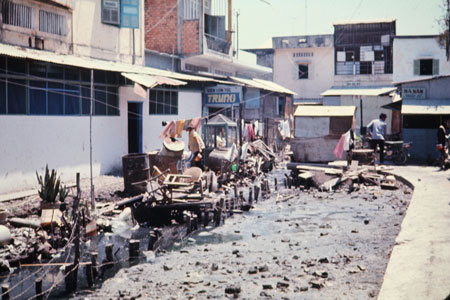
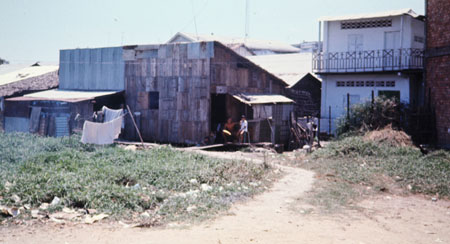
In the photo on the left, it seems that there was trash thrown
onto the ground.